For decades, ranking on Google was survival. Now ADWEEK reports that some of the biggest media businesses are not-so-quietly making plans to disappear from it.
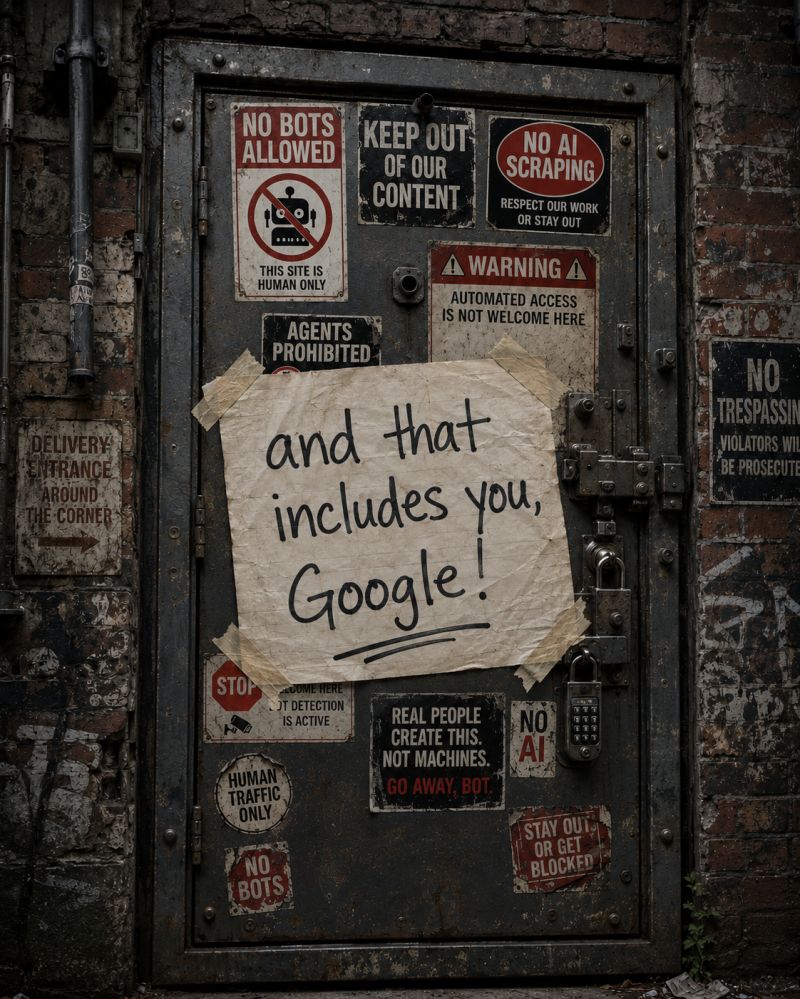
This isn’t just one angry newspaper. The Wall Street Journal lists USA Today, Reuters, Politico, The Economist and People Inc. among the publishers who are considering cutting off Google. And Cloudflare, which sits in front of a fifth of the web, is flipping its defaults to block the crawlers that scrape for both search and AI training.
What changed?
Publishers have always known this dependence was a risk. This is not a revelation. What changed is that the relationship has stopped being a two-way exchange. It’s lopsided.
Neil Vogel, CEO of People Inc., calls Google an “intentional bad actor” for using the same crawler for both search and AI, but he admits People still can’t block it without losing the search traffic it depends on. People Inc is “probably heading towards more confrontation than productivity.”
(I’ve watched Vogel speak a few times recently and he inspires confidence. He seems to have a firm grasp of the industry and an actual plan.)
This Google trap is why the open web matters. It isn’t because of nostalgia or a blind love of all things open source. It’s because ownership and portability increases resilience.
Traffic comes and goes. Ownership compounds.
But the sharp media newsletter A Media Operator makes the case that “No One is Going to Block Google” and the math backs them up. When a publisher still gets over 40% of its traffic from search, walking away from Google is a top-line bloodbath. Google’s Liz Reid reinforces the symbiotic relationship: “Search is not a useful product if the web is not a thriving product.” And Future’s Mike Peralta asserts: “[AI is] nothing but a hallucination without our content.” The industry is also too fragmented for everyone to leave Google all at once, and that’s the only version where blocking actually moves Google.
So will publishers push the big red button? I doubt it, and it doesn’t really matter if a few of them do.
The preparation is the actual prize here. Building newsletters, direct audience, licensing revenue, and owned infrastructure makes you stronger whether you ever block a single crawler or not. Silicon Valley has a word for this: antifragile, systems that get stronger under stress.The exercise of getting ready to survive without Google is exactly what makes you the kind of business that never has to.
The goal isn’t to leave Google.
The goal is to build a business that could if it has to, and no longer has to care whether it does.

